Mention of ‘Murthal’ conjures up images of delicious ‘Parathas, Butter and Curd/Lassi’ combo.From the raw material of basic wheat flour to the prompt serving of finished products in the form of mouth watering parathas, one can learn the basics of Value Addition in Business !!
I have been travelling on GT Karnal Road for decades now. No doubt that food on the entire highway from Delhi towards Haryana/Punjab is really good.
There used to be days of the glory of Puran Singh Dhaba and its clones in Ambala. With changes on the highway and flyovers, they somehow lost out.
The ‘Murthal dhabas’, near Sonepat, also faced this challenge of a new flyover, making them inaccessible. But they relocated a little ahead and continued to do roaring business ….. their Strategic Foresight enabling them to come out of Adversity even Stronger !!
While there are many restaurants and motels on the entire highway that side, the cluster of Murthal dhabas continues to hold a special place for travellers on that stretch.
Market Leaders Gulshan, Sukhdev, Ahuja mastered the core competence of ‘wheat flour to the prompt serving of delicious parathas’ and followed it up with Justplainandsimple™ Specific, Methodical and Consistent Processes !!
And surprisingly, the whole cluster seems to be basking in the glory of these Market Leaders who have occupied a Clear, Consistent and Unique Brand position.
Prompt Serving of QualityParathas.
This is the flagship on which the business is built. However, for the highway traveller, they offer a whole range of uniformly good quality vegetarian fare too while they stop over to indulge their taste buds.
And as the popularity increased, these dhabas have scaled up to match their capacity with the flow of customers, retaining the base ambience and quality and service levels consistently, firing their Economic Engine with Profit/table/hour.
With a clear Sense of Direction and Discipline as a business, there are a whole lot of MBA lessons (Murthal Business Administration) to be learnt ….. specially the focus on ‘Resource Leverage for Operational Excellence’ !!
Fielding, like HR, has been seen as a Support Function in cricket for too long;
till Jonty Rhodes changed the game and said a Fielder can win matches.
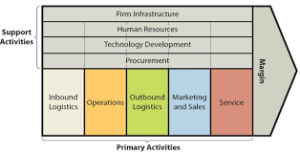
Ask anyone and the most probable answer is “Yes, HR is a support function”. Whenever I interview for HR positions, I hear candidates reinforcing this with a great sense of pride and confidence.
I feel that the search for a good HR person is the most critical and also the toughest. For every function, as would be practice with most of us, functional experts validate technical understanding of candidates. In the final round we check more for cultural and values fit. For HR, however, ‘functional’, ‘values’ and ‘culture’ domains tend to merge at some level. Smart candidates manage ‘correct’ answers with great elan !!
As one of the differentiators, I started asking an open ended question “HR is a support function; what are your views ?” Answers reveal a lot about core beliefs and thoughts related to this point.
In one such round, after a particularly good interaction, we were very sure of a candidate’s selection. And then he went on to rave about how HR is a ‘support’ function. Even to indicative hints of possibilities of direct impact, he strictly reinforced his belief in the concept of providing ‘support’ only.
In the same round, another candidate spoke strongly about the direct impact HR could make as an inherent part of the business. This person, who was selected, later went on to become group HR head of a large business group and then CEO of one of the group companies.
This is not to say that every HR person would or should want to be or aspire to be a CEO. Nor to say that every HR person would or should have core business or other skills needed to be a CEO. It is upto each individual and his/her priorities.
However, a belief that HR is mainstream in the value chain, as integral or with as much impact as sales or marketing or production (content in knowledge organisations), can help businesses and HR people both in achieving more harmonious and successful trajectories.
By the way, the logic holds true for other functions, which believe themselves to be ‘support’ functions, as well. No surprise that this further leads to these functions being classified as ‘overheads’ waiting to be slashed anytime or rather all the time. A self reinforcing self amplifying runaway loop.
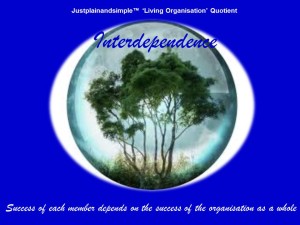
Living systems are integrated wholes whose properties cannot be reduced to those of smaller parts. Throughout the living world, we find systems nesting within other systems. At each level the observed phenomena exhibit properties that do not exist at lower levels. The systemic properties of a particular level are called ‘emergent’ properties, since they emerge at that particular level.
So also, in organisational terms, collaboration is not about gluing together existing egos. It is about the ideas that never existed until everyone entered the room.
In systems view, we realise that the objects themselves are networks of relationships, embedded in larger networks. Symbiosis, the tendency of different organisms to live in close association with one another (like the bacteria inside our intestines), is a widespread and well known phenomenon. Symbiogenesis : creation of new forms of life through permanent symbiotic arrangements is now seen as the principal avenue of evolution for all higher organisms.
There is a lot to learn from ‘Living Systems’.
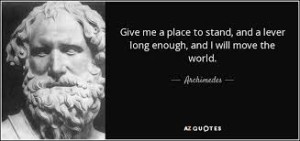
HR can achieve so much more in a Justplainandsimple™Strategic Way, by establishing organisational core competencies in line with business foresight and sense of direction, reinforcing the strategic architecture, building on strategic intent, leveraging to achieve a stretch through the resources it can impact and batting with brand style and tonality ….. on the front foot, to hit the ball over the stands for a six !!
All this rather than ‘supporting’ businesses by maintaining and ticking ‘checklists’ and ‘dashboards’ of low impact, low sustenance activities.
Through mechanisms and processes at its command and ability to leverage and impact the quantity and quality of one of the top two line items in the P&L (cost of goods and people depending on the industry), HR can create a competitive advantage for the organisation. A causal advantage effecting more customers or beneficiaries (for not for profit organisations) to choose to buy more or more often or be willing to pay more for the organisation’s products and services.
Or help cause to create a cost advantage that can be passed on to customers or captured as ‘surplus/profit’ in the P&L ….. a diving run out to win you the match when 2 runs are required by the opponents to win off 1 ball !!
Let’s ask any entrepreneur the question : Why does your business exist ??
Their answers will get bucketed in only two Justplainandsimple™ reasons and in this order :
1)Creating Value for the customer
2)Creating ROI for the Owner
Only if the customers see value, will more of them buy your products and services (n); more frequently (f) and pay you more (p). The cumulative product of these is Revenue (R) i.e. n X f X p. So, value creation is a necessary condition !!
If the entrepreneur does not make a return on his/her resources (after and inspite of and because of providing Value to the customer), there is no reason for them to be in business. Simply put, there could be other uses they can put their resources to, with better risk weighted returns.
However, one could argue, that there is another case/option of Creating Value without looking for returns. A ‘charity/donation’ framework !? This has different implications, which may not be sustainable too. A lot of ‘not for profit’ organisations get caught in this trap. Let’s use this as an example at one end of the spectrum to demonstrate a point.
The logic works like this. It is a ‘not for profit’ organisation, so profit is not an objective to be sought.
Hence, starting at the top of the P&L, fine tuning and polishing the Value Offering to yield optimal R = n X f X p loses significance. This leads to suboptimal product/service offerings coming from this sector. No wonder so many ‘charity’ organisations have gathered a connotation of sub standard offerings.
Next casualty in line is productivity. Since it is ‘not for profit’, squeezing every expense line for productivity is not key. This takes a very critical role in a ‘for profit’ organization.
Hence what flows down at the base of the P&L, is ‘NO PROFIT’ ….. a self fulfilling prophecy !! From where do resources come for funding the loss or resources for growing the scale or further expansion of scope ?? More donation !! Sustainability is affected.
What is needed to flow out, even in such an example of a ‘not for profit’, is a SURPLUS at the base of the P&L after revenues and expenses have been churned. Whatever purpose that surplus maybe put to. Not for returns to owners, but for building scale, for reaching more beneficiaries, for further investments ….. !?
So whether we call it ‘profit’ or ‘surplus’ the significance is clear. QED.
Reasonable surplus or how much is enough, is a matter for another debate related to human greed and we keep it out of the scope of this discussion for the time being. Needless to say, Profit or surplus is a necessary but not sufficient condition. Therefore we have new concepts of triple bottom line coming up : profit, people and planet.
If profit is a requirement that has to be met, we get answers in the way we define it. Right in the beginning of this article, I indicated the second reason for the existence of businesses to be ‘creating ROI for the owner’.
The entrepreneur is looking for ROI. So relative ROIs from different opportunities are compared and investments made. Defining profit this way, helps us in understanding and resolving this issue creatively.
Profit cannot be made mathematically by increasing prices and cutting expenses. Pricing the product to the market is the key. More customers (n) are not going to pay more (p) or buy more frequently (f) than the value they attach to the offering.
Also, you cannot cost cut your way to glory. There will be expenses, there will be costs. Understanding ‘what adds most value to the customer’,to empathise, allows the business to focus and allocate expenses in areas that are important for value creation and hence to reap benefits of leverage and productivity ….. this is rewarded by the right customers (n) buying at the right frequency (f) at the right price (p) !!
Fundamentally, business is ‘philosophy’, not mathematics.
The answer to ‘Profits in low income markets’ therefore lies in creativity and innovation. To find ways of increasing productivity, efficiency and effectiveness.
Nature teaches us various ways in which a dynamic balance is maintained in ecosystems. An organism (organization) picks up signals from its environment (market reading) and makes structural changes within to respond intelligently and in turn influences the environment. This enables it to learn, co-exist and evolve continuously. The story of evolution is a story of collaboration of species and co-existing/co-evolving symbiotically.
Who influences whom then ? The environment and organism keep the whole ecosystem in a harmonious dynamic balance, playing a continuous dance !! So also should organisations and low income markets ….. a continuous dance of celebrating harmony in an interdependent partnership ….. with flexibility and respecting and honouring integrity and diversity in action !!
This was first published in the Ennovent Blog: Innovations for Sustainability
Testimonial67
I am sure the entire team will benefit from the guidance and support of a stalwart like you and your guidance and help will be most appreciated by all of us. Looking forward a significant and successful year 20XX. I am sure that with the team which we have now and a person like you guiding the team strategically, we can be the most admired company in India very soon.
Testimonial66
We are grateful to you.
Dear Mr. Singh,
I wish to convey my deepest gratitude to you for sparing your valuable time for designing and imparting such a wonderful and practical training programme for us. All of us, including the participants and the Chiefs of locations are extremely thankful to you. The training went off very well. Hope to have a long term relationship with you.
Testimonial64
Thanks very much for wonderful, invigorating training sessions for our staff. I feel and am very much sure that the staff has been sensitized to this very important aspect of their Job Profiles. I am sure this small step will go a long way in fulfilling the vision and mission of our organisation. Hoping this concept blossoms and flowers across the organization.
Regards,
Testimonial63
Dear Mr. Singh,
After reading the true story of XYZ Bakery in detail, I was highly thrilled. I am fully convinced that continuous improvement is the real secret of success. Japanese who were badly devastated by the second world war have come up very strongly to face the super powers only due to their firm conviction in 'continuous improvement'. Thanks for sending a highly inspiring story of success.
Regards,
Testimonial61
Pleasure has been ours too ! Students thoroughly enjoyed ! I was also moved by the film on leadership. I wish to see it again. Perhaps I shall borrow from you sometime during your next visit .
Propose you become a friend of our institute and you have a standing invitation to attend whatever you wish to and you can come here anytime - treat this as your institute ! Welcome as a Friend Forever
Testimonial48
Mr. JP Singh posses one of the sharpest marketing brain, a quick thinker & decision maker, under whose leadership team members always feel confident of support & assured of being taken care of.
Deepak Malaviya
CEO at DENIAR
Testimonial47
JP had an eye for the future , passionate,leads by example, he invited creativity with lot of zest and vigour. He has made Managers better effective leaders. He created the eyecare revolution in India. A teacher and a great Boss from whom I have learned a lot.





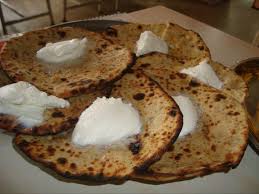 Mention of ‘Murthal’ conjures up images of delicious ‘Parathas, Butter and Curd/Lassi’ combo. From the raw material of basic wheat flour to the prompt serving of finished products in the form of mouth watering parathas, one can learn the basics of Value Addition in Business !!